
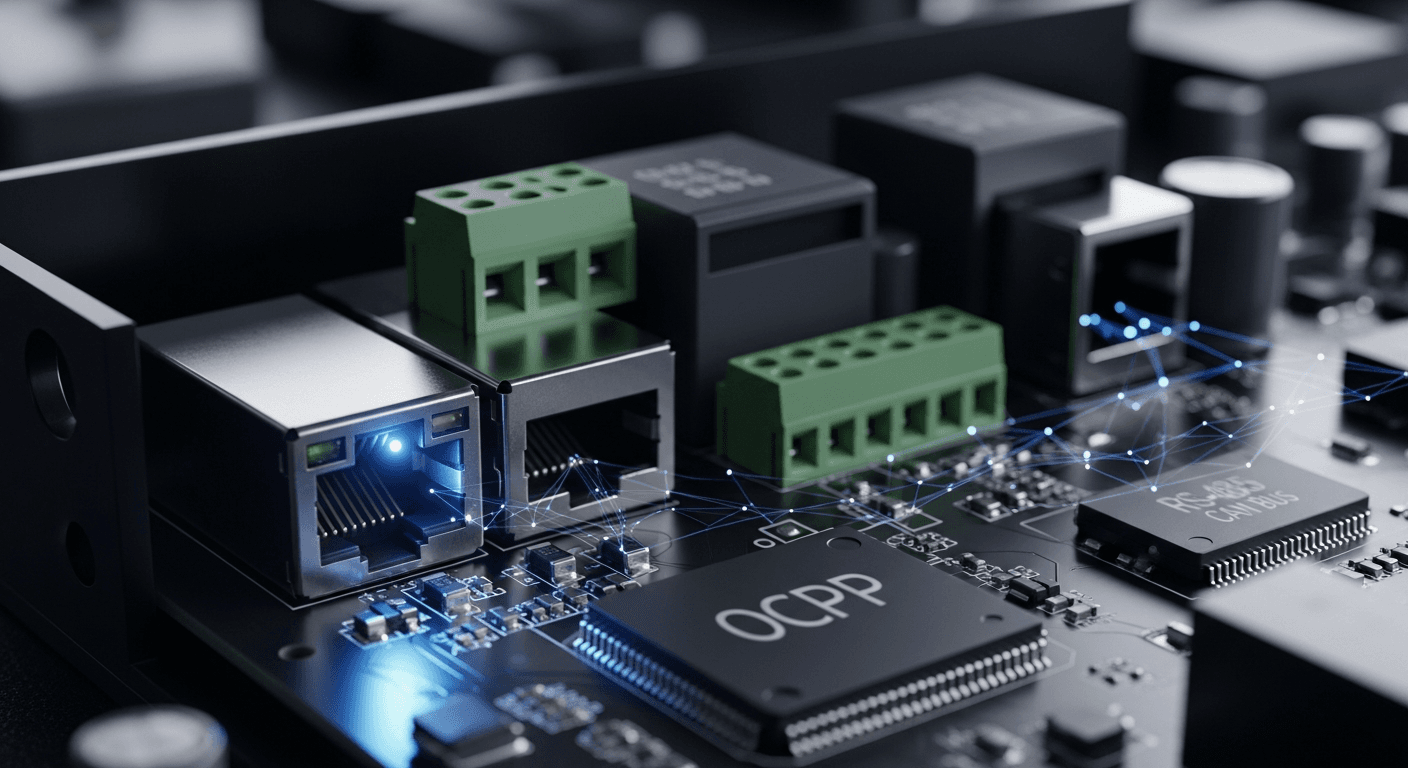
Most discussions of OCPP 2.0.1 focus on the new message set — smart charging profiles, ISO 15118-2 integration, device management. What gets less coverage is the hardware interface implications: what changes on the PCB, what changes in the communication IC selection, and what the firmware team needs from the hardware designer.
Communication Interface Changes
OCPP 1.6 was commonly implemented over WebSocket with either Ethernet or cellular backhaul. The message format (JSON over WebSocket) remains unchanged in 2.0.1, so the physical transport is not directly affected by the protocol upgrade.
However, OCPP 2.0.1's security extensions (Appendix L) mandate TLS 1.2 minimum, with TLS 1.3 strongly recommended. This has a real hardware consequence: microcontrollers running TLS handshakes in software incur significant computational overhead. At 2.0.1, the expectation of certificate-based mutual authentication means a hardware security element (HSE) or dedicated TLS offload IC becomes important for constrained embedded targets.
Hardware recommendation: Consider a dedicated TLS/crypto co-processor (e.g., ATECC608A or equivalent) if your main application processor is a Cortex-M4 class device or smaller. The AES and ECC acceleration pays for itself in handshake latency reduction and frees the main core for charging control loops.
Isolation Requirements
OCPP 2.0.1's DeviceManagement functional block allows remote firmware updates and configuration changes over the network. This raises the security boundary question: your network interface must be isolated from safety-critical circuits (CP signal generation, contactor control) at both the hardware and firmware level.
On the PCB, this means:
- Galvanic isolation between the Ethernet/LTE module and the power control domain
- Separate power domains with clearly defined crossing points
- Hardware watchdog that the OCPP stack must service — if the network interface is compromised and crashes the firmware, the contactor must open on watchdog timeout
Display and HMI Interface
OCPP 2.0.1 introduces a Display functional block that allows the backend to push messages to the charger's user interface. If your charger uses a serial display (SPI/I²C connected LCD or e-paper), this is a software concern. But if you are designing a modular charger where the HMI panel is a separate PCB, OCPP 2.0.1's display message support is a reason to include a higher-bandwidth inter-board communication bus (CAN or UART with DMA) rather than relying on a slow serial link.
Metering Accuracy
OCPP 2.0.1's MeterValues messages support signed meter data (OCMF format), enabling legally valid billing metering. If your target market requires MID/NTEP certified billing metering, the energy meter IC must be certified independently of the OCPP implementation. Hardware designers need to budget PCB area and isolation for a certified meter IC early in the design phase — retrofitting certified metering to a board that wasn't designed for it is expensive.
Summary
The jump from OCPP 1.6 to 2.0.1 does not change your Ethernet PHY or LTE module, but it does change the security posture requirements enough to justify a hardware security element, tighter isolation between network and power domains, and a more capable metering subsystem if your markets require certified billing.