
THE CHALLENGE
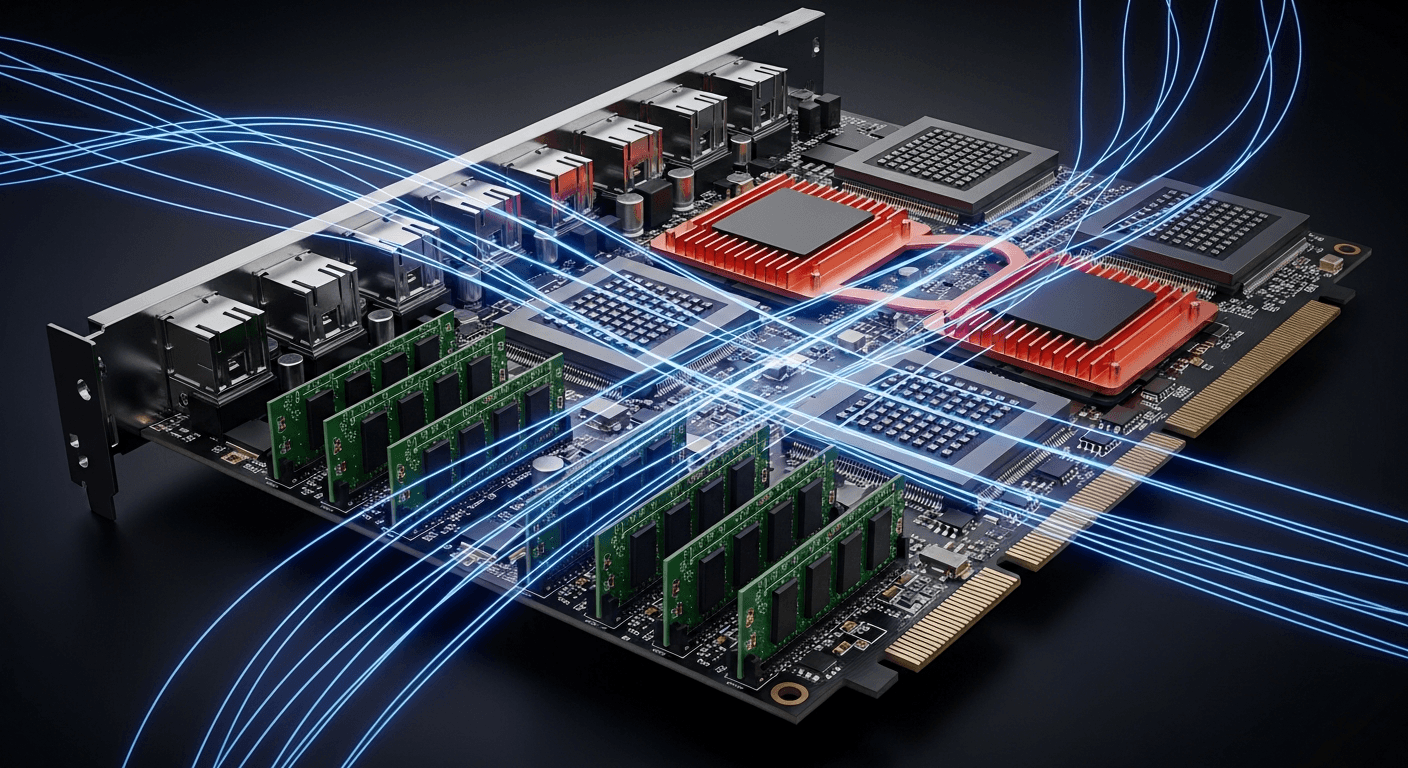
Custom PCIe Gen 3 hardware interface for edge AI inference module. High-speed signal integrity at 8GT/s with strict EMI constraints.
THE SOLUTION
HDI PCB with controlled impedance routing, length-matched differential pairs, optimized de-emphasis settings, thermal management for sustained compute loads.
RESULTS & OUTCOMES
8GT/s full PCIe 3.0 bandwidth verified
EMI pre-compliance testing passed
Thermal design validated at 70°C ambient
Ready for production transfer
This engagement delivered a custom PCIe Gen 3 hardware module for an edge AI inference platform targeting industrial deployment. Achieving full 8GT/s bandwidth at the PCIe 3.0 specification across a custom carrier board is a signal integrity challenge requiring precise layout and careful equalisation tuning.
Signal Integrity Methodology
The design process started with channel modelling in HyperLynx SI before any PCB layout. Target impedance was 85Ω differential for the PCIe lanes. The HDI stackup uses controlled-impedance microstrip on outer layers and stripline on inner layers for sensitive high-speed nets.
All PCIe lane pairs were length-matched within 5mil intra-pair and 150mil inter-pair skew budgets. Via stubs on the differential pairs were back-drilled to minimise stub resonances that would otherwise create insertion loss notches within the 4GHz PCIe 3.0 Nyquist bandwidth.
De-Emphasis and Equalization
Transmitter de-emphasis settings were tuned using a vector network analyser to measure insertion loss of the physical channel, then selecting the appropriate pre-set coefficients for the retimer IC. Eye diagram measurements at the far end confirmed compliance with the PCIe 3.0 receiver eye mask.
Thermal Management
The inference module operates under sustained AI workloads that drive junction temperatures toward device limits. A copper thermal spreader with controlled interface material thickness was designed and validated to maintain junction temperatures below limits at 70°C ambient in still air.
◆ SIMILAR CHALLENGE?
Let's Scope Your Project
Eight years of production-proven hardware expertise — from first topology decision to regulatory sign-off.